When the power goes out, most people assume it'll be back on within the hour. Maybe two. That's usually true for a blown transformer or a storm-damaged line. But a prolonged outage — whether from a cyber attack on the grid, a severe weather event, or infrastructure failure — unfolds very differently.
Here's what actually happens, hour by hour, when the electricity doesn't come back on.
Hour 0–1: Confusion
The first thing you notice is the silence. The fridge stops humming. The heating clicks off. If it's evening, the house goes dark.
Most people reach for their phone. If you've got mobile signal, you'll probably see nothing useful — just other people asking what's happening on social media. The 105 power cut helpline (run by your local Distribution Network Operator) will either be jammed or give you a vague estimated restoration time.
What's happening behind the scenes
- The National Grid Electricity System Operator (ESO) is scrambling to identify the cause and isolate the affected area.
- Your local Distribution Network Operator (DNO) — UK Power Networks, Northern Powergrid, SP Energy Networks, or one of the others — is dispatching engineers.
- If it's a cyber incident, the National Cyber Security Centre (NCSC) is being briefed. This changes the timeline significantly — you can't just reconnect a cable when the control systems themselves are compromised.
What you should do
- Check that it's not just your house — look outside, check with neighbours.
- Report the outage on 105 (free from mobiles and landlines).
- Dig out torches. Do not use candles if you can avoid it — house fires spike during power cuts, and the fire service will already be stretched thin.
- If you have a power bank, start charging your phone now rather than waiting until it hits 10%.
Hours 1–6: Mild inconvenience
At this stage, most people still assume it's temporary. You might eat the leftovers in the fridge (which is fine — a full fridge stays cold for about 4 hours if you keep the door shut, a freezer for up to 24 hours).
What starts to bite
- Central heating stops. Even gas boilers need electricity for the pump, controls, and ignition. In winter, your house starts cooling. A well-insulated home loses roughly 1–2°C per hour in cold weather.
- Hot water runs out. Once the tank's empty, that's it.
- Electric hobs and ovens are useless. If you've got a gas hob with manual ignition (a match or lighter), you're in luck. Most modern gas hobs have electric ignition and won't work without power.
- Phone signal may degrade. Mobile masts have battery backup, typically lasting 4–8 hours. After that, coverage drops off sharply.
- Lifts stop working. In blocks of flats, this becomes a serious issue for elderly and disabled residents.
What you should do
- Fill containers with water while the taps still work. Water treatment plants and pumping stations have backup generators, but they carry limited fuel — typically 24–48 hours' worth.
- Eat perishable food first. Leave tinned and dried goods for later.
- If it's cold, put on extra layers. Consolidate the household into one room and close the doors to rooms you're not using.
Hours 6–24: Reality sets in
By now, you've probably accepted this isn't a quick fix. The phone signal is patchy or gone. The radio becomes your primary information source — BBC Radio 4 on FM (93.5 MHz in most areas) or your local BBC station.
What's happening
- Traffic lights are out. Major junctions are gridlocked. Police are trying to manage the worst ones manually, but they can't be everywhere.
- Petrol stations can't pump fuel. The pumps are electric. Queues form at any station with a backup generator.
- Cash machines don't work. Neither do card payment terminals. If you don't have cash at home, you can't buy anything.
- Supermarkets may close or operate on a cash-only, limited-stock basis. Without refrigeration, chilled and frozen stock is deteriorating.
- Water pressure may drop. If the outage is widespread and backup generators at pumping stations run out of diesel, water pressure falls. In multi-storey buildings, upper floors lose water first.
- Landline phones (proper copper PSTN lines) used to work during power cuts because the exchange provided power. BT completed the switch to digital (VoIP) landlines across the UK, so most landlines now need mains power and a broadband router to work. If yours is digital, it's dead.
What you should do
- Ration your phone battery. Turn off Wi-Fi, Bluetooth, and unnecessary apps. Put it in aeroplane mode except when you actively need it.
- If you have a battery-powered or wind-up DAB/FM radio, this is when it becomes essential. The Roberts Play 10, Pure One Mini, or even a cheap wind-up radio from Argos will do.
- Check on vulnerable neighbours — elderly people, those with medical equipment that needs power, families with very young children.
- If you have a camping stove (Campingaz Bistro 300, about £20, or a Trangia), you can boil water and cook basic meals. Use it outdoors or in a very well-ventilated area — carbon monoxide from gas stoves in enclosed spaces kills people during every major power outage.
Hours 24–48: The difficult bit
You've been without power for a full day. The novelty has well and truly worn off.
What's happening now
- Your freezer food is thawing. After 24 hours without power, most freezer contents are no longer safely frozen. Cook what you can and eat it, or discard it.
- The house is cold. In a UK winter, an unheated house will be around 5–8°C by now. That's uncomfortable and, for vulnerable people, dangerous. Hypothermia can set in at indoor temperatures below 16°C for elderly people.
- Water supply is unreliable. Some areas may have lost water pressure entirely. Even where water is flowing, treatment may be compromised if backup generators have run dry.
- Sewage systems are struggling. Sewage pumping stations need electricity. In flat areas that rely on pumped sewage (much of eastern England, parts of London), toilets may stop flushing or sewage may back up.
- Mobile networks are largely down. The battery backups on most masts are exhausted. You might get intermittent signal near masts with solar backup or in areas where portable generators have been deployed.
- Shops are running out of essentials. Supply chains are disrupted. Deliveries aren't arriving. What's on the shelves is all there is.
What you should do
- Water is now your priority. The NHS recommends a minimum of 2 litres per person per day for drinking, more in warm weather or if you're physically active. If the taps are still working, fill every container you have — pots, pans, clean bins, bathtub.
- If you need to purify water, a rolling boil for one minute makes most tap or collected water safe. Water purification tablets (Oasis or Aquatabs, available from Boots or outdoor shops) are a good backup.
- Layer up. Wear a hat indoors — you lose a significant amount of heat through your head. Sleeping bags and extra duvets make a big difference.
- Keep one room warm by closing it off and using body heat. Four people in a small room with the door closed will noticeably raise the temperature.
Hours 48–72: Endurance
By the third day, you're in genuine survival mode. This is where preparation makes all the difference.
What's happening
- Emergency services are overwhelmed. Police, fire, and ambulance are dealing with a surge of incidents — house fires from candle use, carbon monoxide poisoning from indoor generator or stove use, medical emergencies from people whose powered equipment has failed, road accidents, and rising crime as opportunists take advantage.
- Hospitals are on backup power but rationing non-essential services. A&E is for genuine emergencies only.
- Community response is kicking in. Local authorities will be setting up rest centres — usually in community halls, leisure centres, or churches — with heating, hot food, and charging points. Listen to your local radio for locations.
- Information is scarce and unreliable. Without the internet, rumours spread fast. Stick to official sources: BBC Radio, local authority announcements, and emergency services communications.
What you should do
- Assess your remaining supplies. How much water, food, and fuel (for camping stoves) do you have? Can you stretch it for another 24–48 hours?
- Consider whether you need to go to a rest centre. If you have vulnerable people in your household, no water, or no way to stay warm, this is the sensible choice. There's no shame in it — that's what they're for.
- Pool resources with neighbours. Share cooking fuel, food, and information. Take turns checking on vulnerable people in your street.
- Keep a routine. It sounds odd, but maintaining regular meals and sleep times helps morale significantly, especially for children.
What most people get wrong
"I'll just go to the shops"
By hour 24, shops are either closed, stripped bare, or cash-only. If you don't have supplies at home already, you're relying on other people's generosity or government assistance.
"My gas boiler doesn't need electricity"
Yes it does. The pump, thermostat, and ignition all need mains power. Without electricity, your gas central heating is a metal box that does nothing.
"I'll charge my phone in the car"
You can, but your car has a finite amount of fuel, and the petrol stations can't pump. Use the car for charging sparingly, and don't idle the engine for long periods in an enclosed space.
"The water will keep running"
Possibly, for a while. But water infrastructure depends on electric pumps. Even in areas with gravity-fed supplies, treatment plants need power. After 24–48 hours, all bets are off.
"It won't last that long"
For a standard infrastructure failure, probably not. For a cyber attack on grid control systems, the NCSC's own planning assumptions include outages lasting days to weeks. Hope for the best, prepare for the worst.
The essentials that get you through
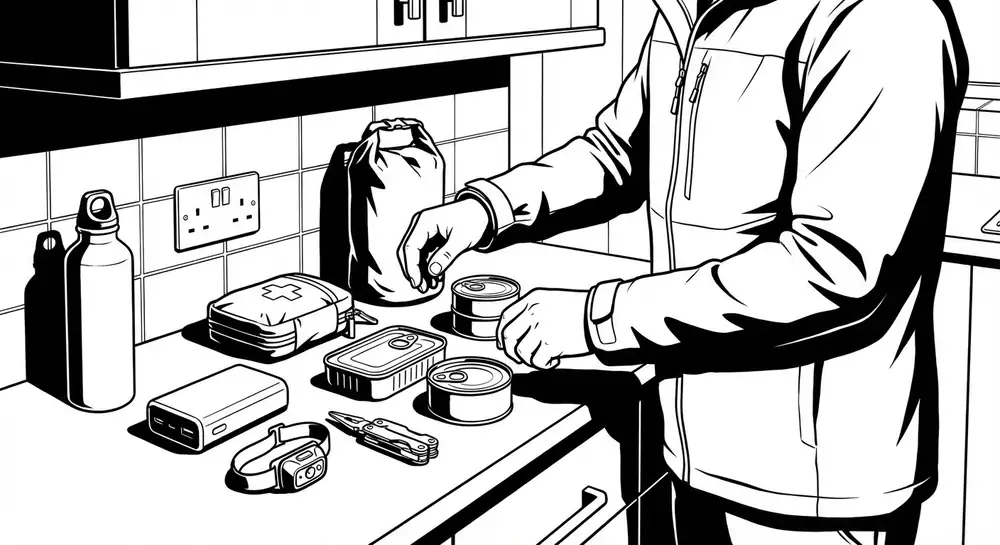
You don't need much to ride out 72 hours in reasonable comfort. Here's the minimum:
| Item | Why | Approximate cost |
|---|---|---|
| LED torches + batteries | Light after dark | £10–15 |
| Battery/wind-up radio | Emergency information | £15–30 |
| USB power bank (20,000 mAh) | Phone charging | £20–30 |
| 9 litres of water per person | Drinking water for 3 days | Free (tap water in containers) |
| Tinned food for 3 days | Meals that don't need refrigeration | £15–20 |
| Camping stove + gas | Cooking and boiling water | £20–30 |
| Cash (£50–100 in small notes) | Purchases when cards don't work | N/A |
| Warm layers and sleeping bags | Staying warm without heating | Already own (hopefully) |
| Basic first aid kit | Managing minor injuries | £10–15 |
| Whistle | Signalling for help if needed | £2–3 |
Total: roughly £90–145, most of which you probably already have or can pick up in a single trip to Argos, B&Q, or your local outdoor shop.
The bottom line
A 72-hour blackout is not the end of the world. It's deeply inconvenient, it's uncomfortable, and for vulnerable people it can be dangerous. But with basic preparation — water, food, light, warmth, information, and cash — you can get through it without drama.
The people who struggle most are the ones who assumed it couldn't happen. Don't be one of them.