Most of us flick a light switch without thinking twice. Electricity is just there. But the system that delivers it — the National Grid and the web of regional distribution networks — is increasingly exposed to cyber threats. Understanding why helps you understand what you're actually preparing for.
How the UK grid works (the short version)
The UK grid is a complex chain:
- Generation — Power stations, wind farms, solar farms, and interconnectors to France, Belgium, Norway, and the Netherlands produce or import electricity.
- Transmission — The National Grid ESO (Electricity System Operator) balances supply and demand across the high-voltage transmission network.
- Distribution — Regional Distribution Network Operators (DNOs) like UK Power Networks, Western Power Distribution, and Northern Powergrid step the voltage down and deliver it to homes and businesses.
- Smart systems — Increasingly, all of this is managed by computerised control systems known as SCADA (Supervisory Control and Data Acquisition) and, more recently, cloud-based platforms.
Every link in this chain is a potential target.
Why the grid is vulnerable
Legacy systems running modern networks
Much of the UK's energy infrastructure was built decades ago. The control systems running power stations and substations were designed in an era when "network" meant copper cables between two rooms, not the internet.
These legacy SCADA systems were never designed with cybersecurity in mind. Many run outdated operating systems — some still use variants of Windows XP — and were built to be reliable, not secure. Retrofitting security onto systems that weren't designed for it is expensive and difficult.
The smart grid expansion
The UK is rapidly modernising its grid to handle renewable energy, electric vehicles, and smart meters. By mid-2025, over 30 million smart meters had been installed across Great Britain.
This modernisation is necessary, but it massively expands the attack surface. Every smart meter, every internet-connected substation controller, every cloud-based management platform is a potential entry point. The more connected the grid becomes, the more ways there are to attack it.
Supply chain risks
The grid doesn't exist in isolation. It relies on software and hardware from vendors around the world. A vulnerability in a single supplier's firmware could affect thousands of substations simultaneously.
The SolarWinds attack in 2020 showed how supply chain compromises work — attackers infiltrated a software provider and used routine updates to gain access to thousands of organisations. Energy infrastructure is not immune to this approach.
Nation-state threats
The National Cyber Security Centre (NCSC) has repeatedly warned that hostile nation-states are actively targeting UK critical national infrastructure. In its 2024 Annual Review, the NCSC highlighted that the threat to the UK's critical infrastructure is "enduring and significant."
Russia's GRU has been linked to attacks on power grids in Ukraine in 2015 and 2016, causing blackouts affecting hundreds of thousands of people. These weren't theoretical exercises — the lights went out and stayed out for hours. The techniques used are well understood and could be adapted for use against the UK grid.
China-linked groups have also been identified inside Western critical infrastructure networks, reportedly pre-positioning for potential future disruption.
Renewable intermittency compounds the risk
The UK's shift towards wind and solar means the grid is already operating with tighter margins. A cyber attack wouldn't need to take down the entire network — disrupting the grid's ability to balance supply and demand during a period of low wind or high demand could trigger cascading failures.
On a cold, still winter evening when demand peaks and wind generation drops, the system is already under strain. A well-timed cyber attack on the balancing systems could tip it over the edge.
What a successful attack could look like
This isn't science fiction. Based on real-world incidents and NCSC threat assessments, a successful cyber attack on the UK grid could involve:
- Disruption of SCADA systems controlling substations, causing localised or regional blackouts lasting hours to days
- Manipulation of grid balancing systems, causing frequency instability that triggers automatic shutdowns across the network
- Compromise of smart meter infrastructure, potentially affecting billing systems or, in a worst case, being used to simultaneously switch loads to destabilise the grid
- Data destruction that makes it difficult for operators to understand the state of the network and restore service
The most likely scenario isn't a dramatic, Hollywood-style total blackout. It's a messy, confusing series of outages affecting different regions, lasting days rather than hours, with unreliable information about when power will be restored.
What the government is doing
The UK has several layers of defence:
- The NCSC provides guidance, threat intelligence, and incident response support to critical infrastructure operators
- The Network and Information Systems (NIS) Regulations 2018 require essential service operators (including energy companies) to manage cyber risks and report incidents
- Ofgem has a cyber resilience programme and works with DNOs on security standards
- The National Grid ESO runs regular cyber exercises and has invested in security operations centres
These measures are real and meaningful, but no defence is perfect. The attackers only need to succeed once; the defenders need to succeed every time.
What this means for you
You cannot control whether a nation-state launches a cyber attack on the UK grid. But you can control how well prepared your household is for the consequences.
The practical takeaway
A cyber-induced power outage looks exactly like any other power outage from your end. The lights go off, the heating stops, the fridge starts warming up, and your phone battery starts its slow descent towards zero.
The difference is duration. A storm-damaged power line gets fixed in hours. A cyber attack on grid control systems could mean outages lasting days to weeks while operators identify the compromise, clean their systems, and restore service safely.
What you should do
- Assume the grid will fail — not because it definitely will, but because preparing for a few days without power is cheap and easy compared to the alternative.
- Have lighting sorted — torches, head torches, battery lanterns. LED versions last ages on a set of batteries. The Varta Indestructible range is solid and available at most hardware shops.
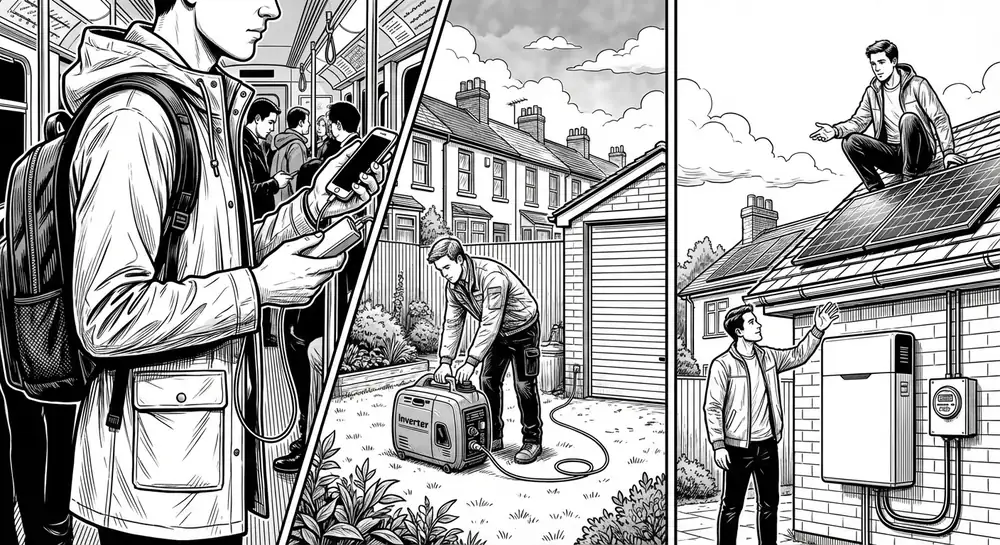
- Keep devices charged — a decent USB power bank (Anker 20,000 mAh or similar, around £25) keeps your phone alive for days. Charge it regularly.
- Stay informed — a battery-powered DAB radio (Roberts Play 10 or similar, around £30) means you can receive emergency broadcasts when the internet and mobile networks go down.
- Food and water — even three days of tinned food, a camping stove (Campingaz Bistro 300 is about £20), and 9 litres of stored water per person transforms a crisis into an inconvenience.
- Cash — card payments won't work without power and internet. Keep £50–100 in small notes at home.
- Know your neighbours — community resilience is the most underrated prep there is. When the power goes out, the street that shares information, resources, and skills will cope far better than one where nobody talks.
The bottom line
The UK grid is not about to collapse. The lights will almost certainly stay on tomorrow, and the day after, and the day after that. But the cyber threat to our energy infrastructure is real, it's growing, and the potential consequences are serious enough that sensible preparation is just common sense.
You don't need to build a bunker. You just need a torch, a power bank, some tinned food, and a plan. That's not paranoia — that's being a grown-up.