Turn on the tap and clean water comes out. It's so reliable that most of us never think about it. But the UK's water supply is entirely dependent on electricity — and when the power goes out, the clock starts ticking on your taps.
How UK mains water actually works
Most people assume water just flows downhill from a reservoir to their house. That's partly true, but the reality is more complicated — and more fragile.
The chain from source to tap
- Abstraction — Water is drawn from reservoirs, rivers, or underground aquifers. In England and Wales, about a third comes from groundwater and two thirds from surface water. Scotland relies more heavily on surface water from lochs and reservoirs.
- Treatment — Raw water goes through treatment works where it's filtered, chemically treated (usually with chlorine), and tested. There are roughly 1,200 water treatment works across England and Wales alone.
- Pumping — This is the critical bit. Treated water is pumped through a network of mains pipes to service reservoirs (usually concrete tanks on hilltops) and then to your home. The UK has approximately 1,500 pumping stations.
- Pressure — The system maintains pressure through a combination of gravity (from elevated service reservoirs) and electric pumps. Normal UK mains pressure is between 1 and 3 bar.
Every stage after abstraction requires electricity. Treatment works need power for filtration, UV sterilisation, and chemical dosing. Pumping stations need power to move water uphill and maintain pressure. Even the monitoring systems that check water quality are electrically powered.
What happens when the power fails
Hour 0–6: Pressure starts dropping
Water companies are classified as "Category 1 Responders" under the Civil Contingencies Act 2004, which means they're required to have emergency plans. Major treatment works and key pumping stations have backup diesel generators, and most hold 24–72 hours of fuel.
But here's the catch: not every pumping station has a generator. The network has hundreds of smaller booster stations that maintain pressure in specific areas. These are the first to fail.
What you'll notice: Initially, nothing. Service reservoirs typically hold 12–24 hours of supply for their area. But if you're at the end of a long main, on a hill, or in a high-rise flat, you may notice reduced pressure within a few hours.
Hours 6–24: Service becomes unreliable
As smaller pumping stations lose power:
- High-rise buildings (above about 6 storeys) lose water first. Many rely on internal booster pumps that need mains electricity.
- Hilly areas see pressure drop as the pumps that push water uphill go offline.
- Dead-end mains (cul-de-sacs and rural properties at the end of a supply line) lose pressure before properties on ring mains.
Water companies will be prioritising their generator fuel for the biggest treatment works and the pumping stations that serve hospitals, care homes, and other critical sites.
| Location type | Likely time to lose pressure | Why |
|---|---|---|
| High-rise flat (above 6th floor) | 2–8 hours | Internal booster pumps fail |
| Hilltop property | 6–18 hours | Booster pumps serving the area fail |
| End of a rural supply line | 6–24 hours | Low priority for generator deployment |
| Average suburban home | 12–48 hours | Service reservoir drains |
| Near a major treatment works | 48–72+ hours | Generator-backed supply continues |
Days 1–3: Emergency supply kicks in
If the outage continues beyond 24 hours, water companies activate their emergency response plans:
- Bowsers (mobile water tanks on trailers) are deployed to key locations — usually supermarket car parks, community centres, and other accessible points.
- Bottled water stations may be set up, often using supplies from the supermarket distribution network.
- Water tankers can connect directly to the mains network to maintain supply in critical areas.
The statutory requirement is that water companies must provide a minimum of 10 litres per person per day during an emergency. For context, normal UK daily usage is about 150 litres per person — so 10 litres is survival-level supply only.
What about the quality?
When pumps lose pressure, there's a risk of ingress — contaminated groundwater or soil water seeping into the mains through joints and cracks. Normally, the positive pressure inside the pipes prevents this. When pressure drops, contamination can get in.
This is why water companies often issue boil water notices after major supply disruptions, even once the taps are flowing again. It takes time to flush the system and confirm the water is safe.
What "10 litres per person per day" actually means
The emergency minimum of 10 litres per person per day covers:
- Drinking: 2–3 litres (more in hot weather or if you're physically active)
- Cooking: 2–3 litres (boiling pasta, making rice, reconstituting food)
- Basic hygiene: 3–4 litres (hand washing, essential cleaning)
It does not cover:
- Flushing the toilet (a standard UK toilet uses 6–9 litres per flush)
- Bathing or showering (a 5-minute shower uses roughly 40 litres)
- Laundry
- Washing up properly
This is bare minimum survival. It's enough to keep you alive and reasonably clean, but it's not comfortable.
How to prepare: water storage at home
The basics
The simplest prep for any water disruption is stored water. The government's own advice (from the National Risk Register guidance) suggests having enough drinking water for 3 days.
For a household of two adults, that's a minimum of:
- Drinking and cooking: 20 litres (2 people × 5 litres × 2 days, plus buffer)
- Hygiene and other uses: 20 litres
- Total: roughly 40 litres
40 litres sounds like a lot, but it's only eight 5-litre bottles — about the space of two carrier bags on a kitchen floor.
Storage options
| Method | Cost | Shelf life | Notes |
|---|---|---|---|
| Commercially bottled water (supermarket own-brand) | ~30p per 2L | 12–24 months (sealed) | Easiest option. Stack a few packs in a cupboard. Tesco, Aldi, and Lidl all sell 2L bottles for around 17–30p each. |
| Food-grade jerry cans (fill from tap) | £5–10 per 10L can | Replace every 6 months | Available from Halfords, Go Outdoors, or Amazon. BPA-free HDPE plastic is what you want. |
| WaterBob or similar bathtub bladder | £25–30 | Fill when warning received | Holds ~120 litres in your bath. Only useful if you have advance warning. |
| IBC tote (1,000 litres) | £40–80 secondhand | Long-term with treatment | Only if you have garden space. Needs treating with Certisil Combina or similar. |
Rotation
Tap water stored in clean, sealed containers is safe for at least 6 months. Commercially bottled water lasts much longer — the "best before" date is about the plastic degrading, not the water going bad.
The easiest rotation system: buy a few packs of supermarket water and put them at the back of the cupboard. Use the front ones for normal drinking. When you buy new ones, they go to the back. Zero effort, always fresh.
Water purification: when storage runs out
If your stored water runs out and the mains isn't flowing, you'll need to purify water from other sources — rainwater, streams, or even collected grey water for non-drinking uses.
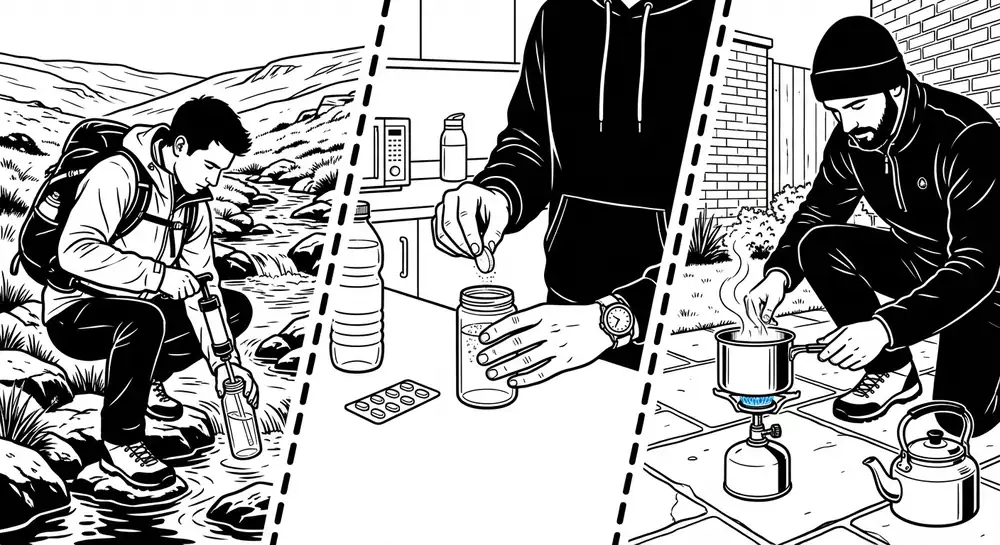
Boiling
The simplest and most reliable method. A rolling boil for one minute kills virtually all pathogens. This works for bacteria, viruses, and parasites including Cryptosporidium (which is resistant to chlorine).
You'll need a way to boil water without electricity. Options:
- Camping stove — A Campingaz Bistro 300 (about £20 from Argos) with butane cartridges is the most common choice. Each cartridge gives roughly 1.5 hours of cooking time.
- Kelly Kettle — Uses small sticks and twigs as fuel. The Trekker model (about £50) boils 600ml in 3–5 minutes. No fuel to store.
- Wood fire — If you have a garden and a fire pit or similar. Slower but unlimited fuel if you have access to wood.
Purification tablets
Chlorine dioxide tablets (such as Oasis or Aquamira) kill bacteria and viruses effectively. They're cheap (about £5 for 50 tablets from Boots or Amazon), lightweight, and have a shelf life of several years.
Important: Most purification tablets don't kill Cryptosporidium. If you're purifying water from an unknown source and can't boil it, you need to filter it first.
Portable filters
The Sawyer Mini (around £25) and the LifeStraw (around £20) are the two most popular portable filters available in the UK. Both remove bacteria and parasites to 99.99% but do not remove viruses — which is fine for UK water sources where viral contamination is rare, but worth knowing.
For belt-and-braces safety: filter first, then treat with purification tablets. This covers bacteria, viruses, and parasites.
Toilet flushing: the unglamorous essential
When the water stops, the toilet becomes a surprisingly urgent problem. A family of four might flush 30–40 times a day under normal circumstances.
Manual flushing
You can flush a toilet by pouring a bucket of water directly into the bowl — about 6 litres per flush. You don't need clean water for this. Rainwater, grey water from washing up, or water collected from any non-drinking source works fine.
Keep a bucket or watering can near the toilet and have a plan for collecting non-potable water.
Reducing flushes
The old camping rule applies: "if it's yellow, let it mellow; if it's brown, flush it down." Unpleasant to discuss, but genuinely important when water is scarce. A family of four can reduce toilet water usage from 200+ litres per day to about 30 litres.
Rainwater collection
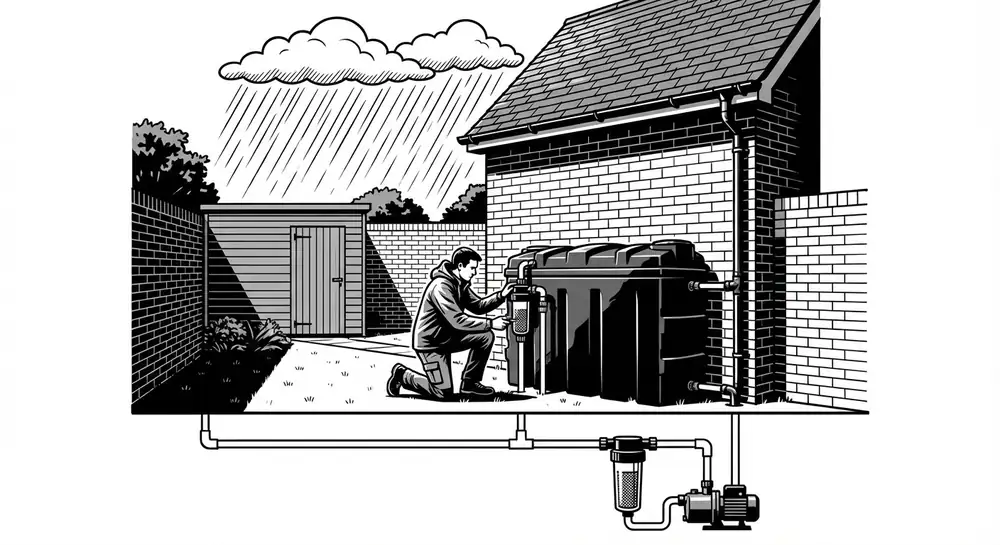
The UK's average annual rainfall is about 1,150mm — we get plenty of rain. A standard UK roof of 50 square metres can collect roughly 50 litres of water per millimetre of rainfall. Even a modest rain shower of 2–3mm yields 100–150 litres.
In an emergency, the simplest collection method is positioning buckets, bins, or tarpaulins under downpipes or roof edges. This water is not safe to drink without treatment (bird droppings, atmospheric pollutants, roof contaminants), but it's perfectly adequate for:
- Flushing toilets
- Washing clothes
- Cleaning
- Watering any food you're growing
With proper filtration and purification (filter, then boil or treat with tablets), rainwater can be made safe for drinking too.
What you should do today
You don't need to overhaul your life. Here's a sensible starting point:
- Store 20–40 litres of water — Buy a few packs of cheap supermarket water or fill some food-grade jerry cans from the tap. Store them somewhere cool and dark.
- Get a way to boil water — A camping stove and a few gas cartridges. You probably need this for general emergency cooking anyway.
- Buy purification tablets — A £5 pack of chlorine dioxide tablets from Boots is cheap insurance. Store them with your water.
- Think about your toilet — Have a bucket or watering can you could use for manual flushing, and think about where you'd collect non-potable water.
- Know your situation — Are you in a flat or a house? On a hill or in a valley? At the end of a supply line or near a treatment works? This tells you how quickly you'll lose water in a power cut.
The bottom line
UK tap water is safe, reliable, and cheap. But it depends entirely on electricity, and electricity isn't guaranteed. Storing some water and having a basic purification method isn't paranoid — it's the same common sense that makes you keep a spare tyre in the car.
The cost of basic water preparedness is about £30–40 and an hour of your time. The cost of not being prepared, when the taps stop flowing, is considerably higher.