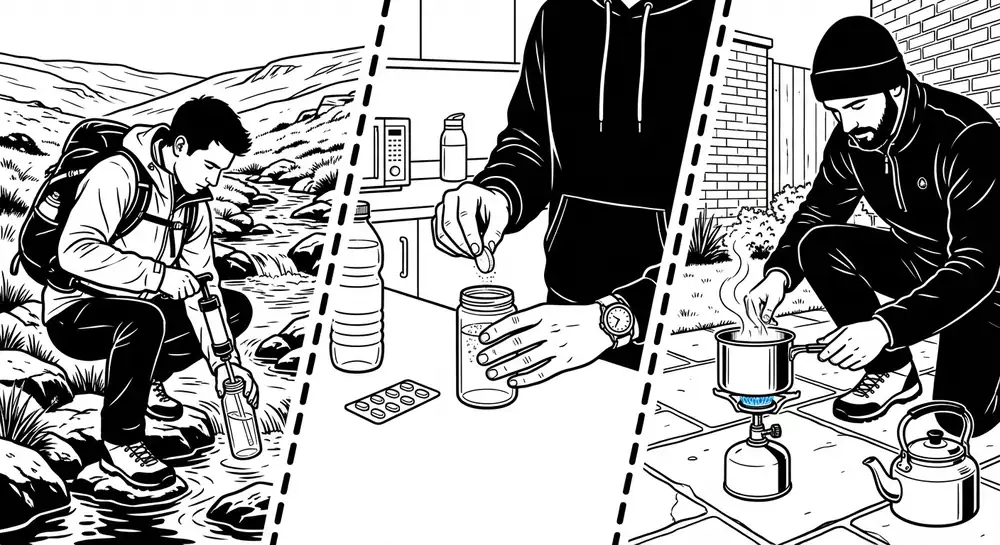
Stored water runs out. When it does — or if you're forced to use water from an untreated source like a stream, rainwater butt, or even a swimming pool — you need a way to make it safe to drink. The wrong method, or the wrong order of methods, can leave you with water that looks clean but will make you seriously ill.
This guide compares every realistic purification method available to UK preppers: what each one actually removes, what it costs, its limitations, and when it's the right choice.
What's actually in untreated water?
Before comparing methods, it helps to understand what you're dealing with.
| Contaminant type | Examples | Size | Risk |
|---|---|---|---|
| Sediment | Dirt, sand, rust, organic matter | Visible | Blocks filters, unpleasant |
| Bacteria | E. coli, Salmonella, Cholera | 0.2–5 microns | Severe illness, potentially fatal |
| Protozoa | Giardia, Cryptosporidium | 1–15 microns | Severe gastrointestinal illness |
| Viruses | Norovirus, Hepatitis A, Rotavirus | 0.02–0.3 microns | Severe illness |
| Chemicals | Pesticides, heavy metals, industrial runoff | Molecular | Cancer risk, organ damage |
In the UK, the biggest risks from untreated surface water are bacteria and protozoa. Viruses are less common but not impossible, especially in water contaminated by human sewage. Chemical contamination is a concern near industrial or agricultural land.
Method 1: Boiling
How: Bring water to a rolling boil for at least 1 minute.
What it removes: Bacteria, protozoa, and viruses — all killed by heat. Boiling is one of the few methods effective against all three biological threats.
What it doesn't remove: Sediment, chemicals, and heavy metals. If the water is cloudy, pre-filter it through a clean cloth, coffee filter, or t-shirt to remove particulates before boiling.
Cost: Free (if you have a heat source).
Pros:
- Extremely effective against all biological contaminants
- No special equipment beyond a pot and heat source
- No chemicals or consumables needed
- Everyone understands how to do it
Cons:
- Requires fuel — gas canisters, firewood, or a camping stove
- Slow — heating 2 litres takes 5–10 minutes, then it needs to cool before drinking
- Uses valuable fuel that you may need for cooking
- Doesn't remove chemical or particulate contamination
Best for: Your primary purification method when you have fuel. The gold standard for biological safety.
UK-specific note: A Kelly Kettle (from about £40) boils water efficiently using small sticks and natural fuel — no gas canisters needed. Very popular with UK outdoors folk for good reason.
Method 2: Gravity-fed filters
How: Pour untreated water into the top chamber. Gravity pulls it through ceramic or carbon filter elements into a clean lower chamber.
Examples: Berkey, Doulton, ProOne, British Berkefeld.
What they remove: Bacteria, protozoa, sediment, and many chemical contaminants (depending on the filter element). Some models claim virus removal too, but check the specific test data.
What they don't remove: Not all chemical contaminants. No filter removes dissolved salts (you'd need distillation or reverse osmosis for that).
Cost: £150–300 for a complete system. Replacement filter elements last 6,000–20,000 litres and cost £50–80 per pair.
Pros:
- No fuel, electricity, or pumping needed
- Large output — 10+ litres per hour depending on model
- Very long filter life
- Removes sediment and improves taste
- Can be used daily as a normal water filter (some people use them full-time)
Cons:
- Expensive upfront
- Bulky — not portable
- Slow compared to pumping or boiling a small amount
- Ceramic elements are fragile — can crack if dropped
Best for: Home base water purification during an extended disruption. If you can afford one item on this list, a gravity filter gives you the most capability.
UK-specific note: Doulton is a British company (Stoke-on-Trent) and their ceramic filter technology is used in aid and disaster relief worldwide. The Doulton DUO or a British Berkefeld system are excellent UK-sourced options.
Method 3: Pump filters
How: Manually pump water through a filter cartridge. Input hose goes in the dirty water, output goes into your clean container.
Examples: MSR MiniWorks, Katadyn Pocket, Katadyn Hiker Pro.
What they remove: Bacteria, protozoa, and sediment. Most pump filters do NOT remove viruses (pore size is typically 0.2 microns — too large to catch viruses).
Cost: £50–150 for the filter. Replacement cartridges £20–40, lasting 1,000–50,000 litres depending on model.
Pros:
- Portable and packable
- Faster than gravity filters for small quantities
- Good output for their size
- No fuel or electricity needed
Cons:
- Physical effort required — tiring over large volumes
- Don't remove viruses (unless combined with a chemical purifier)
- Cartridges can clog with very silty water
- Moving parts that can break
Best for: Bug-out bags and situations where you need to move. Good for filtering water from streams and rivers while travelling.
Method 4: Straw and squeeze filters
How: Drink directly through the filter (straw) or squeeze water through it into a container (squeeze filter).
Examples: LifeStraw, Sawyer Mini, Sawyer Squeeze.
What they remove: Bacteria and protozoa. The Sawyer filters are rated to 0.1 microns and are among the best in this category. Viruses are generally not removed.
Cost: £15–30.
Pros:
- Incredibly lightweight and compact
- Very cheap
- No moving parts
- Sawyer filters last for hundreds of thousands of litres
Cons:
- Low flow rate — drinking through a straw filter is slow work
- Not practical for filtering large volumes
- LifeStraw has a limited lifespan (about 4,000 litres)
- Don't remove viruses or chemicals
Best for: A backup in your emergency kit or rucksack. Not a primary household solution, but excellent as a lightweight insurance policy.
UK-specific note: The Sawyer Mini is available from Cotswold Outdoor, Go Outdoors, and Amazon for about £25. Arguably the best value water filter available.
Method 5: Chlorine dioxide tablets
How: Drop a tablet into a litre of water, wait 30 minutes (or up to 4 hours for Cryptosporidium).
Examples: Oasis, Aquamira, Katadyn Micropur.
What they remove: Bacteria, viruses, and most protozoa. Chlorine dioxide is effective against Cryptosporidium (unlike plain chlorine), but requires a longer contact time (4 hours).
Cost: About £5–8 for 50 tablets (50 litres).
Pros:
- Extremely lightweight and compact — a pack of 50 fits in a pocket
- Long shelf life (5+ years unopened)
- Effective against viruses (which most filters miss)
- Very cheap per litre
Cons:
- 30-minute wait before drinking (4 hours for full Cryptosporidium kill)
- Slightly unpleasant taste (reduced by aerating or adding a tiny amount of vitamin C)
- Doesn't remove sediment or chemicals
- Consumable — once you've used them, they're gone
Best for: A lightweight backup alongside a filter. Excellent for treating water that's already been filtered (filter removes sediment and protozoa, tablets kill any remaining viruses).
UK-specific note: Oasis tablets are the standard issue for the British military and are widely available from outdoor shops and Amazon.
Method 6: Household bleach
How: Add 2 drops of unscented household bleach per litre (sodium hypochlorite 4–6%). Stir and wait 30 minutes. The water should have a faint chlorine smell.
What it removes: Bacteria and viruses. Less effective against protozoa (Cryptosporidium is resistant to chlorine).
Cost: Essentially free — you probably already have bleach under the sink.
Pros:
- Free and already in your home
- Effective against bacteria and viruses
- Simple method that anyone can use
Cons:
- Doesn't kill Cryptosporidium reliably
- Doesn't remove sediment or chemicals
- Easy to get the dosage wrong (too little = ineffective; too much = harmful)
- Must be unscented, unfragranced bleach — many UK brands add fragrance
Best for: A last-resort method when nothing else is available. Good for treating tap water for long-term storage.
UK-specific note: Domestos Original (the plain blue one, not lemon or pine-scented) is 4.5% sodium hypochlorite and works for this purpose. Always check the label.
Method 7: UV purification
How: Insert a UV pen into a litre of clear water, stir for 60–90 seconds. UV light destroys the DNA of microorganisms.
Examples: SteriPEN, CrazyCap (UV water bottle).
What it removes: Bacteria, viruses, and protozoa — UV is effective against all three.
Cost: £50–80 for a SteriPEN.
Pros:
- Fast — 90 seconds per litre
- Effective against viruses, bacteria, and protozoa
- No chemicals or taste impact
- Compact and lightweight
Cons:
- Requires batteries or USB charging
- Only works with clear water — sediment blocks UV light
- Treats small volumes (1 litre at a time)
- If the device breaks or runs out of battery, you have nothing
- Expensive for what it does
Best for: A secondary method for travel. Not recommended as your only purification method — too dependent on batteries.
The comparison table
| Method | Bacteria | Viruses | Protozoa | Sediment | Chemicals | Fuel needed | Cost | Portability |
|---|---|---|---|---|---|---|---|---|
| Boiling | Yes | Yes | Yes | No | No | Yes | Free | N/A |
| Gravity filter | Yes | Some | Yes | Yes | Some | No | £150–300 | Low |
| Pump filter | Yes | No | Yes | Yes | No | No | £50–150 | Medium |
| Straw/squeeze | Yes | No | Yes | Partial | No | No | £15–30 | High |
| Chlorine dioxide tablets | Yes | Yes | Yes* | No | No | No | £5–8/50L | High |
| Household bleach | Yes | Yes | Partial | No | No | No | Free | N/A |
| UV pen | Yes | Yes | Yes | No | No | Batteries | £50–80 | High |
*Requires 4-hour contact time for Cryptosporidium.
The recommended approach
For most UK preppers, the best setup combines two methods:
Home base
- Gravity filter (Berkey, Doulton, or British Berkefeld) — handles large volumes, removes sediment, improves taste
- Boiling as backup — kills everything biological, covers you if the filter breaks
On the move
- Sawyer Squeeze or Mini — lightweight, long-lasting, excellent bacterial and protozoan removal
- Chlorine dioxide tablets — kills viruses that the filter misses, tiny and lightweight
Absolute minimum budget
- Boiling — free and effective
- Household bleach — free and covers viruses (which boiling also handles, so this is belt-and-braces)
The key principle: filter first, then treat. Filtration removes particles and most biological threats. Chemical or heat treatment catches anything the filter missed.
Key takeaway
No single method handles everything. The most resilient approach pairs a filter (for sediment, bacteria, and protozoa) with either boiling or chemical treatment (for viruses). Start with what you can afford, and add layers over time.


